Wednesday, 23 September 2020

Back to Normality?

0 comments
This blog post has been many months in the making, so warning, it is rather long. It's worth a browse at least, especially with wonderful videos from Travis and of The Princess Bride, and a few pretty photos taken by me. So far, so normal for me and my blog posts. I initially called this post Back to Normality, but I added the question mark as I don't think anything will ever be truly normal again. It's not the 'world is coming to an end' apocalyptic anxiety-fueled feeling I had at the beginning of lockdown, but a more realistic view that attitudes will have changed forever because of what we've been through. I'm faced with some normality in going back to work next week and I'm both fearing and relishing the prospect. I have been back, briefly, once for some filming and it was surreal, but nice. My body didn't like it though as I got all sorts of aches and pains, including in my wrist, pelvis and butt. I blamed the bicycle at first of course! When you cycle twice a day, 5 days a week, for 7 miles every day, your body gets used it. It has definitely regressed these past 6 months. 6 months! Otherwise, I've been working all through lockdown from home, which I've never wanted to do, mainly because I knew I would enjoy it. I have social anxiety and I'm practically a hermit as it is, only seeing close family on a regular basis. So work interaction is the only thing that stops me from not having a social life altogether and I'm afraid of how much I've regressed in that sense too. But being at work will build that back up with no pressure. 

Screenshot of the filming
Filming at MMLL

Anxiety has been preparing me for the worst for 20 years, with what ifs and thought spirals, so the pandemic hasn't hit me as hard as others in some ways. However concerns about how the virus would impact me, my family and loved ones have caused a lot of anxiety and one of the things that has helped is living in the moment, escapism and writing this blog post. I've been dipping into it every once in a while over the lockdown period and writing it as if lockdown had ended worked. Lockdown has been relatively easy for me, with no one close to me catching it, no one losing their job and no one being furloughed. It has actually limited my anxiety and I'm worried how much it's going to come back when I return to the world properly. But with everything uncertain about whether there will be another lockdown and a resurgence of the virus, I know the anxiety will always be with me. Uncertainty over the return caused some weird anxiety dreams that left me unsettled, but they disappeared once I knew what was happening. Now though, with the increased restrictions and the threat of a second wave just as term starts and I'm going back in to work, I'm not sleeping as well. Last night, I tried all my usual methods of getting back to sleep; I usually wake once in the night between 2-4am, but go straight back to sleep. I resorted to an unorthodox method of doing a puzzle from the puzzle book I keep by the side of my bed, which I dip into every now and again if I'm feeling jittery and it calms the spiralling thoughts in my head down, probably by focusing my mind. I had so many at 2am this morning and the puzzle worked. I'm glad my anxiety disorder is manifesting in tears and dreams and disrupted sleep rather than panic attacks. At this rate, I may have to break into my magic painting book; I loved them as a child and it's a great productive, mindful nostalgia hit.

Forget colouring books!

Lockdown for me started in quite a dramatic fashion. I was due to go on holiday to Costa Rica, where my oldest brother and his family live at the moment, the Wednesday before lockdown. We were determined to still go on holiday as there were no restrictions then, despite the fears of catching the virus in the airport and on the plane. But the day before we were due to leave, the border closed. Our flight still went ahead for repatriation purposes, so we initially received no refund, even though it was effectively cancelled for us; apparently we could still have got on the plane, but we couldn’t get off it. Thousands of pounds just for two 11 hour flights and no holiday? We then got a voucher which would have locked up the money until hopefully the world got back to normal, or we could at least fly again, but it was only valid for 12 months… Finally, after a battle involving numerous telephone calls and emails, with the airline admitting a mistake and a very helpful customer service person working from home on our side, we got our money back. We got all our money back from the holiday in the end from car hire to accommodation, but it took months. We were incredibly lucky as many people are still waiting for their money, especially from BA.

A hummingbird in Costa Rica

After that and still to this day, it's been difficult not to think about where we’d have been if the holiday had gone ahead and if we'll ever get back there. But everyone has been thinking the same, what would they have been doing if the restrictions weren’t in place, plus the holiday would have been so different with restaurants shut, places closed and beaches forbidden. The border has only just starting opening there again, unlike here where it never really closed. There is a comfort in that we're all in this together. The heartbreak for me is that the holiday had been two years in the planning and it was difficult to undo all the preparations. We were visiting family and we have piles of stuff we were going to take out to them that they couldn’t get out there, plus presents as we didn’t see them for Christmas or birthdays. I had last-minute appointments at the dentist's and with my doctor, I got my medication early, stockpiled contact lenses as I wouldn’t have had enough, renewed my passport early, bought new clothes, wore clothes I didn’t want to take on holiday, got a haircut, bought toiletries to make sure I had enough, made packing lists and all were totally unnecessary and were constant reminders of what was not to be. However they came in useful when the country went into lockdown, closing dentists so my tooth pain would have caused me anxiety all through lockdown, hairdressers, making things more scarce in shops and every time you stepped into a shop or doctor's you were at risk, we still are.

A Costa Rican sloth

When I knew the holiday wasn't going ahead, I still had to go to work, but when I found my bike had a puncture and our attempts of fixing it took too long, I phoned work and they told me not to come in as I was on half day anyway, taken so I could pack and prepare for the holiday. That's when I broke down in tears, which were good because it meant I wasn't having a panic attack! All the usual anxiety about going on holiday and flying on a plane, plus the anxiety over the virus came to a head; it was a cathartic release. I called my parents as I was afraid I wasn't going to see them again for weeks, maybe months. This made me cry harder. I had the day off sick, used the rest of the week as leave to sort things out, trying to cancel our holiday and then I started to work from home with everyone else on the Monday.

It took a while to settle, nights were the worst, they always are with my anxiety. I went to bed early each night to stave off the panic; it's better to wake up early with it, than have it interfere with my sleep. That said, I had no real panic attacks, just anxiety attacks and randomly my temperature shot up in the evening, which didn't help as we had no thermometer, all sold out, so I couldn't check if it was a Covid fever or not. I reckon it was anxiety or my endometriosis. In the end, we bought a baby kit just to get a thermometer. Luckily, one of my managers had given me some hand sanitiser before lockdown for our travels, so we had enough of that. After a period of not being able to eat very much, I improved after I realised I’d have to move in with my parents if I didn't get better so they could look after me, like they looked after me after my breakdown in 2013. My fears of passing the virus on to them actually helped me get my act together.

I couldn't have made it through this alone:
me and my brother in Costa Rica

At first, I avoided all news, getting my brother to tell me anything I needed to know; each time I caught something on the news or on an app, I could feel my anxiety rising. He has been a rock during this whole time, generally unflappable, and he worked from home for about 3 years, so he's an old hand at it. As I adjusted to the 'new normal', I felt strong enough to read or listen to the news myself and it became a regular lunchtime tradition watching Nicola Sturgeon's daily briefing; she was much more reassuring, assured and compassionate than the PM. Other things that helped get me through were Orkney Library's jigsaws, Only Connect style walls and webcams; I got my fix of the outside and more global world from zoo cams, the Salisbury cathedral peregrine falcon webcam, the Tresco island live cameras of the beach and gardens, as well as Arenal volcano in Costa Rica. We checked in with my parents every day to ease my mind and theirs after dinner, swapping news, sharing photos and doing quizzes and puzzles; I send them the Times polygon every day.

Early on, I got a weird cough that I couldn’t cough that sat on the top of my chest that meant I couldn’t breathe as easily. This was not good as it mimics anxiety attack symptoms, but it was not as bad as it could have been because it also means I’m used to living with these symptoms. Knowing that every cough, either my own, from someone close to me, or a stranger created paranoia, we kept in the house, but as it didn't fit the symptoms and we had no others, when it went away after a few days, with my brother having it after me, we didn't isolate.

The coaster on my desk, John Ruskin

If I was furloughed, I don't think I would have coped, or gone into a film and TV induced escapist coma. Luckily, I could work from home, but only after some computer woes, working on my brother's laptop while we sorted out a PC for me; my PC is Windows 7, so that was automatically out. Luckily, I was given a free Windows 10 PC when I was at Homerton. I tried to stick to my usual hours for familiarity's sake. Creating a routine was crucial; routines are a boon for anyone with anxiety. That said, I tried not to replicate my old routine at home as it would have been a mental health crutch. I used it as an opportunity to be more flexible, as much as you can be with restrictions in place, such as having different things for lunch rather than my usual sandwich. I still woke up at 6.30am every day despite not setting my alarm anymore, though that is when the heating comes on and the boiler is in my room, but it continued over the Summer too. I didn't do much with my extra hour in bed, I needed it to read the news and wake up properly, as without my morning commute to wake me up, it was difficult to get my brain cells moving in the mornings. Separation between work and home was also less easy. I wore comfortable clothes and no make-up, contact lenses or jewellery. When I had to switch between working for one library and the other, I would use my lunchtime to switch mindsets or have a quick break. I used my dressing gown as a way of telling my body I’ve finished work and watched an episode of something between work and having our dinner as a stop-gap. Creating a distinction between the weekend and weekdays, was not just getting up later and no work, I tried to do different tasks each day, but despite my best efforts, sometimes the days blurred.

I kept my same core hours of work, allowing myself more flexiblity in the mornings if I woke up feeling bad. Drinking enough was key, I was so used to drinking from my water bottle all day: instead of a litre water bottle on my desk, I had a small glass which forced me to get up regularly. Getting outside at least once a day helped me feel like I could breathe deeply, shallow breathing was common for me during those first few weeks, even if it was just the back garden: nature is the best soother. My home desk is next to the patio doors to the garden, so I had a lovely lookout and often watched the birds and next door's cats; after one cat downed a pigeon (it went to the vet and was never seen again), we convinced her to put bells on their collars. All was good after that. I did some gardening every day, usually picking up fallen apples and dead-heading roses, which is very satisfying and makes them last longer, we still have some growing even now! We also loved seeing our wild flowers and vegetables growing; our courgettes have been a great success.

Our rose bower

My brother and I developed a lunchtime routine, coordinating our lunch breaks so we could eat together, as far as meetings and workload allowed, and then going for a walk, our one allowed outing a day during the restricted times and sticking to it when restrictions eased. Pokemon Go gave us the impetus to explore our local area and we now have some lovely nature walks across fields and meadows. We saw Spring change into Summer and now Autumn. I miss the quiet roads and empty pavements, now I'm having to adjust to traffic noise again. Each trip out to the shops was atrocious, my anxiety rose and my vestibular system got knocked out. One time, I sat in the car while my brother loaded the shopping, staving off a panic attack. But I knew if I said anything, my parents would insist on doing their own shopping and worries about their health spurred me on. Sometimes we have felt like the parents when they have sneaked out to the shops instead of asking us to. We have considered grounding them! They are in the at risk category due to their age and health conditions, but not in the shielded category. They are definitely taking the pandemic less seriously than their children. Now, shopping trips are mildly aggravating, but I can't wear a mask. I wrote a blog post all about why.

A good thing happened during lockdown; I got so annoyed at the quizzes my brother's workplace was sending round, taken from The Sun or the Daily Mail, that I created my own for them. I themed each week, starting with IT as that's the field they work in, doing three quizzes of 30 questions a week, starting with a word round like anagrams, a general knowledge/trivia quiz and then a picture round each Friday. They loved it so much we were sent a box of chocolates, funded by their HR. But comments I received meant more, especially the one who said it was the only thing that got him through the day: that was early on in lockdown. This then lead to a few of the quizzes being sent round to my work colleagues as well. My favourite was my lockdown landmarks picture quiz, with photos of empty tourist sites around the world. This week is my last week as I won't be able to continue now I'm returning to my workplace, so I'm ending on a high with a music round: name the song from its intro.

My birthday cake

Regarding work, my colleagues have been brilliant, in both libraries in different ways, even sending me a birthday cake! In one library, we had a virtual team meeting every day and had lively discussions on Yammer and Teams, the other library was more hands off with meetings twice a week, which were less about work and more about socialising and checking in with each other. These meetings became fewer as we got into the Summer. There were social meetings for all librarians in our area, so I got to see different faces. I also had rants with my ex-colleagues over Facebook Messenger, mostly about their workplaces and world politics. I found Zoom and Teams meetings quite draining, especially with the larger numbers: one time there were 200 of us! It's when you feel everyone is looking at you, luckily most people turned their cameras off, it was only for the smaller meetings we could see each other. Plus, I find it stressful seeing myself. So I tried to take time out, do things away from the screen when I wasn't working, even if I did one chore a day, it was something. I also took holidays, two weeks at home watching the tennis and trying to be productive, and a recent holiday away to a cottage in the middle of a tiny village. I marked the cancelled events, watching the 2008 Wimbledon final between Nadal and Federer during Wimbledon fortnight, the Glastonbury programmes and the 2012 Olympics opening ceremony when that should have been on, which was the epitome of bittersweet as it made me proud all over again, but I also cried to see how much the word has changed with the referendum and such. Instead of all the video calls, virtual meetings and messaging, the best thing for my social side was embedding myself in the communal aspect of working remotely, mainly joint ventures such as; helping the ebooks team with requests and purchasing, which is still ongoing with my buying ebooks for other libraries, maintaining my knowledge and working in an area I have been involved in for years; deduplication of catalogue records, which has helped me improve my cataloguing skills; and most recently creating an introductory video to our libraries, teaching myself how to use new software. Learning new skills in such challenging times has been a real boon and showed me that I can do more than I realise.

Winnie the Pooh quote

I have tried to be kind to myself, not question or judge myself, just doing what I have to in order to get through. Everyone had grand plans of what they could do with the extra time on their hands. Me, I thought I could start putting together my book idea, but I found it hard even to read books at first, let alone write one. I was going to make good use of the last week before going back in to work, making porridge for breakfast instead of just having one of my Mum's flapjacks and a banana, but that didn't happen. Saying that though, I did listen to more music and took notice of all the things I've been grateful for working from home. Putting on a stone would normally get me down, but I know I will lose weight once I start cycling to work again. If it was watching children's programmes, reading chicklit or binge-watching television, whatever worked. Familiar shows like The Repair Shop, Merlin and my favourite ever TV series Alias, (which is now on Amazon Prime) have really helped. I'm very pleased The Great British Bake Off and Ghosts are back and the new All Creatures Great and Small is very welcome. Another great thing was the lockdown version of The Princess Bride, it was on Quibi, but you can find a taster on YouTube below. I didn't need music as much as I thought, I can't listen to it and work at the same time as I used to, only when doing tasks that don't require much brain power. But when I worked at the police station inputting data, I used to work with music playing all the time. When I played the playlist I made of music from that time, including Ruby by the Kaiser Chiefs, How to Save a Life by Razorlight and Standing in the Way of Control by The Gossip, it reminded me of a time when I was stronger than I ever thought I could be, which was confidence boosting. It also helped to block out the kids playing in the garden next door, while also tapping into happy memories of when life was easier, fooling your brain for a while.


It was okay to let things slide; there’s no need to dress up or wear a bra, put in contact lenses, put on make-up or even wash your hair as regularly, unless you feel you need the mental boost or it’s good for the motivation. I did do more if I was video conferencing though; you have to be more aware of what’s on camera and I made sure what I wore was what I wanted people to see!

Compassion for others was something I let slide for a while, it usually comes naturally to me as I'm a highly sensitive empath and take on the feelings of others, but when I'm in anxiety mode, that disappears. Our neighbours, who flouted lockdown rules, having people from other households over, going out whenever they wanted and even hosting a birthday party in their back garden with many people round, were the subject of many rants. My poor brother also got nagged more than normal as minor irritations became major. Happily, that has improved, though I still nag my brother!


Finally, the essential thing that got me through lockdown, was owning any feelings I had:

  1. Grief over lost holidays, missed celebrations and not seeing loved ones
  2. Denial was necessary to be able to process everything, escapism through TV and films
  3. Sadness that life has changed so much
  4. Anger about how the situation unfolded and was handled
  5. Bargaining, being flexible within the restrictions
  6. Acceptance came as everyone adjusted to the new normal

Pride was the overarching feeling when I look back on it all; not just pride of the NHS, which moved me to tears on numerous occasions, with my very English polite clapping on a Thursday turning to saucepan banging; pride of key workers of which my sister-in-law is one as deputy head of a school; pride of friends and family and how they adjusted to it all; pride of my colleagues and how they carried on regardless; pride of my library community and all the services they have set up, how they have not just muddled through, but adapted; and pride of the University in which I work, world-leading in so many ways, but generous, compassionate and caring throughout, making sure the welfare of everyone is paramount, both mental and physical. There's also pride in myself, not letting my mental health degenerate of course, but also how I've coped with work, learning new skills, making new connections and letting things slide at times, because I have a tendency to say yes when I shouldn't. As a side note, with the lessons learned over the past 6 months, appreciating what you have and those around you more, getting back to nature, slowing down, there have been some professional lessons too: ebook provision coming to the forefront, better relationships and collaboration with faculty over reading lists, working together more with other libraries, accessibility for everyone, disabled or otherwise, being key, and putting mental health first, all of which I have been involved with for years and have been trying to improve. They've all happened at once! I hope the world has changed forever in these regards, and with uncertainty everywhere, we are going to need our families, friends and colleagues now more than ever. I look forward to the day I can hug my Mum again and get a bear hug from my Dad; my brother isn't the most tactile of people, so I haven't had a hug from anyone since March. I may have to stealth hug him if I get desperate!


Finally, on a niche note, I am proud of my favourite band Travis for all they've done to reach their fans during lockdown, including releasing several singles, acoustic versions of their new and older songs and an awesome video of their hit "A Ghost" which the lead singer Fran Healy drew himself and their latest "All Fall Down", showcasing Fran's artistic skills. I see it as a lullaby for adults.


Sunday, 26 July 2020

To mask or not to mask

0 comments
I have always been a law-abiding citizen and technically I still am. So why do I feel guilty? Because I didn't wear a mask in a shop. No one questioned me or even gave me a sideways look, though I felt very self-conscious and paranoid that everyone was glaring at me. Luckily, the supermarket where we do our weekly shop is Sainsbury's and they aren't enforcing the regulations unlike other shops. I want to thank them for not even confronting me for not wearing a mask, as it did cause me anxiety not to wear a mask and it would have made it worse being questioned. Just in case, I downloaded an exemption notice from the government website, planned a speech and rehearsed conversations I might have if asked: it's a symptom of social anxiety, I rehearse phone conversations routinely. I have anxiety enough not wearing one, believe me. But to wear a mask would have been far worse anxiety-wise; in the government's exemption terminology, it would have caused me severe distress. There were others who were unmasked, but they may have had a legitimate reason for being exempt like me. I just hope people don't abuse their compassion. It didn't help that I have been comparing people who do not wear a mask when they should to anti-vaxxers. It's the same principle; you are protecting others by wearing a mask and those who don't are relying on those that do to stay healthy.

Exemption notice
I will wear a mask if I'm nipping in and out of a shop or if it's a small place and I won't be spending much time there, but for larger places, I can't wear a mask. It's not that I don't want to, I really wish I could. It's that I fear what will happen if I do. When the announcement was made, an announcement I was dreading, I tried a mask out, when I picked up my prescription from the pharmacy and on a short car journey. Each was in a very controlled environment, but I felt claustrophobic, as if I couldn't breathe in properly, which is a major problem for someone with anxiety. It's one of the more minor symptoms of my anxiety disorder, usually, but I don't like feeling constricted; I don't like wearing scarves, I don't wear polonecks and when I feel anxious, I have to take off anything that makes me feel my breathing is being restricted, from jewellery to underwear. I never thought it would be an issue, but in these times, it has become one. I hate scenes in TV programmes and films where someone has to take their clothes off when they're having a panic attack, the classic is when they're stuck in a lift, but it is based on fact. So if I have that reaction to things around my neck, imagine how something over my mouth and nose makes me feel. I know masks have no effect on breathing, but anxiety cannot be reasoned with. For some people, masks are uncomfortable, for me, it can induce a panic attack.

I go out to one shop once a week to buy our groceries from the supermarket. I drive and my brother comes too to do our parents' weekly shop. We take 45 minutes or so to do the shopping, it's too much time for me to wear a mask. A few times during lockdown, I have been close to a panic attack due to anxiety about being around other people, fear of catching the virus yes, but not only due to my mental health, but also my physical health. I have a vestibular disorder which means my senses can get overwhelmed by seemingly innocuous factors and supermarkets exacerbate that: the neon lights, the rows of stacked shelves, other people moving about.

I was on the verge of a panic attack once, so much I feared I wasn't able to drive, this would have meant our shopping and our parents' shopping would be ruined. I took a deep breath before turning the engine on and then again when we got home. I know if my parents knew I felt this way, they would instantly say that they will do their own shopping from now on, but I am not prepared to put them at risk; they would be at greater risk as most people do not social distance once they are going round the shop, just queueing outside and at the tills.

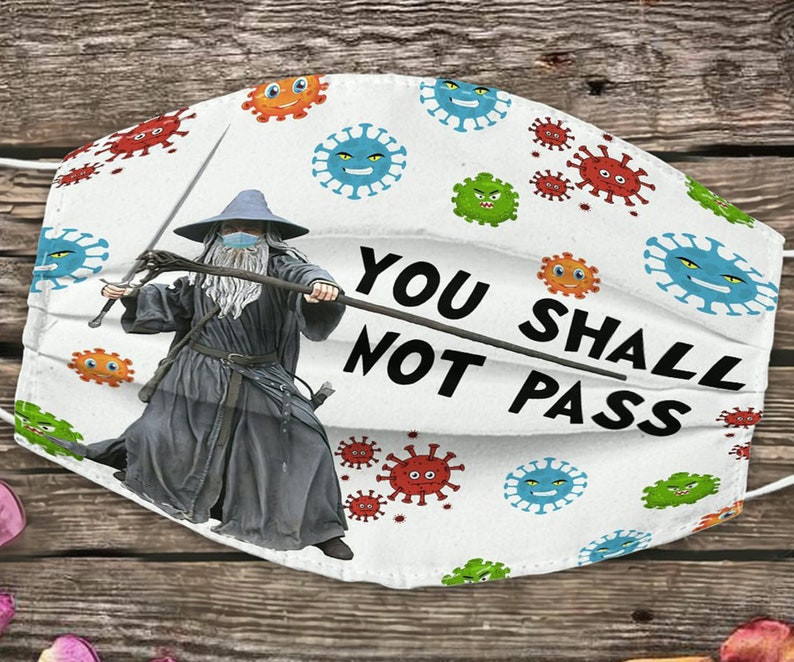
This almost panic attack was before we had to wear masks. People will tell me to try wearing a mask and see how I go, find one I feel comfortable with. I have tried and not one makes me feel anything less than I cannot breathe properly and any symptom of a panic attack can bring on a panic attack with me, even increased heart rate from exercise or excitement. So the longer I have to wear one, the worse I feel and the more likely a panic attack will happen and the more I have to do while wearing one, the worse it is for me. With the added overwhelming of the senses, brain processing I have to do in the supermarket and the risk factor of having to drive afterwards, it is too much for me to wear a mask. You can put cool images on them and it will make me feel no different, even the one with Gandalf wearing a mask saying "you shall not pass" to the virus.

The Gandalf coronavirus face mask, available from Etsy among other places
Once I stop working from home, I don't know what will happen, but my workplace is investigating visors instead of masks, so I'm hopeful. I wish I could wear a mask, I really do. I believe in masks, I believe we should have been wearing them long before. I want to protect others by wearing one, but I cannot do so without severely affecting my mental health and during this time, I have had to protect it and will continue to have to for many months and maybe years to come. People with mental health conditions walk a tightrope, they know that one slip could send them on a downward spiral, and those are very hard to recover from. Even if I'm okay one time, it doesn't mean I will be the next. Mental health can be unpredictable like that. I have to be selfish here, but I have a legitimate reason to be, those who don't, please wear a mask.

Friday, 26 June 2020

The Framework Five - Creation and Communications

0 comments
Information users should also consider themselves information creators, reusing and re-purposing discovered content in different formats. Learners should understand how their discipline’s processes produce, reproduce and disseminate scholarly material. Learners consider their contribution to the body of knowledge through their original work and discipline’s scholarly conversation community of practice.

Personal
During lockdown, I have been creating quizzes, which is almost as enjoyable as taking part in them. This requires research, such as the one where I was finding photos of worldwide landmarks during lockdown. Some were easy such as musicians in films and TV, films based on video games and place names in song titles: that's what Wikipedia is made for! However the more difficult ones were anniversaries in 2021 (Ian Holm would have been 90 next year 😢), songs for our times (such as Don't Stand So Close to Me, Ghost TownYou Can't Touch This, It's the End of the World as We Know It (and I Feel Fine) and my personal favourite Que Sera Sera) and technology predicted by fiction (did you know the author William Gibson invented the word cyberspace?). It was all about how to find the information and then repurposing it into quiz questions. It was easier to search for the information in a way than searching as part of my work as there was a lot out there, but it was more difficult to find accurate sources and use the right search terms. Plus the process and structure of the content was set by me, so there was more scope to work with. I tried to theme the quizzes, such as Cambridge, doing three quizzes per week: one wordy quiz such as missing vowels, one general knowledge with questions and one picture quiz. I've had to revise some of the quizzes to make them fit; the technology predicted by fiction was going to be questions, but it had to change to alternate letters removed as I couldn't make the information I'd found into questions, without them being incredibly difficult anyway.

Finally, sending them proved more difficult as I used Word documents initially, but my edition of Word wasn't compatible with everyone's, so I changed it to PDFs, which has been working fine. I generated enough interest that instead of only my brother sending them to his work colleagues, which is where it started; I got exasperated by them using the ones from The Sun and the Daily Mail; it branched out to family and friends, and now the most applicable ones are going out to my A&H librarian colleagues. I've been broadening the audience through word of mouth. Getting such great feedback, making sure I'm pitching the questions at the right level and choosing appropriate subjects and fun themes has given me such a great confidence boost at this difficult time and has been giving me a welcome distraction. I'm going to do some book-themed questions next, just for my colleagues, or maybe even library-themed, if I can...

Professional
I wrote a series of articles for CILIP Update magazine, before the mass exodus; now I barely know anyone who suscribes anymore. I did it that way as it was a quick turnaround from submission to publication: ebook information can go out of date very quickly, plus I avoided the saga outlined in the Nature article. The articles were repurposed from my PG dissertation for my librarianship degree. I was told not to let all that research go to waste. I suppose my perspective was unique at the time, focusing on the industry and the librarian perspective, not the student experience. The magazine is less formal than academic journals, so I tried to make them entertaining, comparing choosing the right ebook model and platform to dating for instance. The structure and processes were set by the editor and the publication's house style, so working under such restrictions made the writing much simpler. The managing editor and I worked out the length of the articles, the timetable of when each would be published and I found free to use, creative commons images, then worked with the editor to choose the best image for the piece to fit the page. Everyone I worked with was a woman incidentally, apart from the images guy, so I was surprised to read Chawla's article on underrepresentation of women in peer review, but less surprised about the underrepresentation of non-Westerners.

Once I realised how locked down the articles were, only readable through the magazine to subscribers; I thought they'd also go on the website and as blog posts; I made them open access by checking with the editor who let me put them on my LinkedIn page. If you're interested, here they are: https://www.linkedin.com/in/sarahburton3/. The whole process showed me how naive and inexperienced I am, leaving me feeling a little lacking in self esteem. But after the publication there was a lot of great feedback and interest. I was asked to do some presentations at a conference and various meetings. I repurposed the articles into presentations for a formal conference in London and for library peers. There was a lot of repurposing into different formats and for different audiences going on! From dissertation, to articles, to presentations. Although it was a few years ago, the presentation is sadly still applicable as it covers the broad strokes:


P. S. Thank you for highlighting that Claire Sewell's book is accessible as an ebook, I will certainly read the whole of it and not just one chapter.

Friday, 12 June 2020

The Framework Five - Managing Information

0 comments
Learners engage with relevant information in their disciplines, develop workflows and strategically handle many information formats, demonstrating identification, collection and collation. When creating and using information, learners will understand value and ethics. Learners should appropriately attribute, citing their sources and develop practical skills to manage their range and variety.

Personal
I collect Beatrix Potter figures; it's a tradition started by my Granny who gave me a figurine as a present when I was young knowing I loved the books. After she died, my family has continued to give them to me as presents. I have more than 70 now and when it became difficult for my family to keep track of the ones I have, I started to create a list. When I learned my cousin had an accident where some of hers fell off her shelf and got damaged, I thought for insurance purposes I should document them. So I took two photos of each figure: one of the figure itself and one of the bottom where the maker's mark is stamped. Then I input the information into an Excel spreadsheet. When I was given a published collector's guide, I used it to identify the stamps, the variations in age and style and how much each figure is worth. It was also useful to work out which figures I didn't have already and which I would like. I looked at the pictures to see which I prefer and made a wish list. However that guide book quickly became out of date and a new one wasn't published. So I discovered a more recent list which has updated prices for the figures on the internet. So the Excel spreadsheet holds all the information on the figures I have, plus the ones I still need, their age, make, stamp and of course value. I have put it on the cloud as well for insurance purposes in case I lose the hard copy on my computer. It has been very successful for myself, my family has appreciated it as well because they know how much they should pay and it has meant I have been receiving far more figures!

Professional
Like many librarians, I use bibliographic software such as Mendeley or Zotero. I prefer Zotero as it was what I used during my library degree and I taught it during my time at Cambridge Judge Business School in 1-2-1s with students, during live demos in lecture theatres and small group teaching at Homerton College. We always made sure to emphasise that students should get familiar with the software and set it up as early as possible because it would be too late when it came to writing the first essay or assignment. The best work flow is to save everything you look at as you're doing your readings, your research and your searches. Creating folders for subjects, courses or assignments helps organise the sources better and it's easier to find what you need. I also used a Word document alongside it, typing or copying and pasting useful quotes, making sure to add the page numbers with them. This meant I had readymade citations and bibliographies when it came to writing my essays and projects. At Cambridge Judge Business School, we also had a team account and we saved interesting articles, books and electronic resources into it, such as for our Harry Potter themed teaching sessions.

It was as successful as it could be depending on the limitations of the software; it's good practice to check Zotero once you save the item that it had saved properly and make any edits to the information to make sure it was correct, had all the information that was needed and there weren't any weird errors or capitalisation. It also doesn't always recognise the item type, so you save it as a webpage and make the changes yourself manually. Then, when it came to adding the citations and bibliographies from Zotero into Word, they would be accurate. It has been very useful both personally and professionally for me, the teams I worked with and for the students.

In reading this all for thing four and writing this piece, it has made me realise I am equally at home managing information professionally and personally, in all aspects of my life. My examples demonstrate how I have worked with everyone in my life in a professional context and at home. Managing information in an ethical way comes naturally to me as I am a perfectionist, wanting to have all the information possible to hand, giving credit where it's due and needing to know where the information has come from. I feel this part of information literacy is where I'm strongest.

Tuesday, 28 April 2020

Coronaverse

0 comments
The Times diary TLS was asking for coronaverses, rejigging famous poems for the current circumstances. Mine was too long to use, but I got a lovely email back from someone at The Times. It is based on Ozymandias by Shelley:

I met a jogger on a lonely run,
Who said— while two metres from me – “people
stroll in the local parks… Near them, in the sun,
Half asleep a couple lies, whose love,
And lack of care, and sneer of selfishness,
Tell of their heedless concern for the rules.
They may yet survive, but might cause lifeless others,
They mock the hands that help them, these fools
And in the history books, these words could appear:
‘My name is not important, my words more so;
Look on society and despair!’
Only lessons remain. Stop the decay
Protect the NHS, care for its kin
Or the future will rue our today.”

Tuesday, 14 April 2020

Commemoration day

2 comments
The Cambridge sky drawer strikes again

Today would have been my first day back at work after the holiday, the holiday that for many reasons, mostly health but not financial, fortunately didn't happen. It's also the holiday I am mourning as it had been part of my life for almost two years; we'd been planning it ever since we went to Costa Rica to visit my family last time. It's difficult not to think about where we’d have been each day if the holiday had gone ahead, but everyone was thinking the same, what would they have been doing if the restrictions weren’t in place. Plus, even if the borders weren't closed the day before we were due to leave, the holiday would have been so different, spent in lockdown with restaurants shut, places closed and beaches forbidden, but at least we would have been together.

Starling on Ditton Meadows

I have been reminded of it constantly, by us undoing all the bookings, trying to get our money back, in the big pile of things we were going to take out with us, in my niece's recent birthday celebrated virtually rather than in person. It's also in the small things, every time I look at my medications, contact lenses and toiletries I had stockpiled to make sure I had enough, all fortunate now, as well as the haircut I had just before we were due to fly. All have come in useful now we're in lockdown.


Blossom on our Bramley apple tree in our back garden

However I'm owning this grief and the world is grieving due to tragic bereavement, but also the loss of not being to spend birthdays, weddings, anniversaries, Mother's Day and Easter together, the loss of being able to do what we want, when we want. My grief just happens to be more specific, which actually helps having something to focus it on. The holiday grief I'm experiencing is mostly though in the loss of having something to look forward to. Now everything is uncertain. I'm uncertain when I will see my family again in person, when I can hand over the stack of presents, but also when all this is going to end. Everyone's in the same boat I know, but that knowledge doesn't help.

A heron hunting on the River Cam

So in the interest of having something to look forward to, I have made plans to commemorate the things that will no longer happen, it will give the grief some closure. For Easter, I rewatched the film Peter Rabbit as we cannot see the sequel yet now. For my birthday, I won't watch Black Widow in the cinema now, instead I will rent the recent film of Emma and watch it at home. When Eurovision, the Wimbledon final, the Olympics and Glastonbury (not that I got tickets) were supposed to happen, I will watch programmes to celebrate them; I have the 2012 London Olympics DVD and I'll watch the triumphant opening ceremony again, our last great national event. I also have the 2008 Wimbledon final between Roger Federer and Rafael Nadal on DVD, so I'll watch that too; I can't say rewatch as I missed some of it; I was on holiday and we had to go out for dinner, but the match was still going, so we went to the restaurant and they kindly let me eat while watching it in the bar: as I remember it my family joined me for the end of the match with their desserts.

The bluebells we planted

My anxiety disorder thrives on uncertainty, so I need things to look forward, to hang onto, so all this will help for now, it takes me to July at least. I am also writing notes for a blog post about my experiences of this time living with an anxiety disorder, but in the past tense, which gives me hope. On a day-to-day basis, I have my daily nature/Pokemon/exercise walk, my beautiful back garden with its blossoming apple trees and numerous birds, and my birthday bluebells, if we can keep them alive that long! Because this will end, it's the not knowing that's the hardest part. All the photos in this post were taken by me over the Easter bank holiday weekend.

The sky drawer's Easter message + = love

Thursday, 26 March 2020

The Framework Five - Critical Assessment

0 comments
Summary
Critical assessment takes into account the origin, context and suitability of the information being studied, how it is influenced by not only the creator, but everyone involved in handling and disseminating it. These factors determine the authority and therefore credibility of the source of information, the most important assessment.

Personal
There are some very timely examples of critically assessing information I could use as my example: politics such as "he who I don't like to name" (could be one of two people in power to be honest) and Brexit; healthcare with the coronavirus; science with climate change. However all those are depressing and can be downright scary, especially now it seems the whole world has changed. I prefer not to dwell on them too long and the world of misinformation is massive and complex when it comes to these subjects, so this post would be very long otherwise.

I could be very British and talk about the weather, specifically weather apps as they seem to vary wildly, particularly about whether it will rain. But I'm going to get personal, hopefully not too personal. I have three chronic health conditions, meaning I have to live with them as they are not going to go away: anxiety, a vestibular problem and endometriosis. For two of which, I've had to fight the system for treatment and if I hadn't done my own research, I may not have been diagnosed in the first place. So it's something I feel I can talk about with some passion and authority, something I've proved myself in being adept at critically assessing information, but it wasn't always the way. Doctors can easily dismiss things you've looked up on the internet and don't like self-diagnosis, at least in my experience. When it comes to your health, you know when something is wrong; you know yourself, your body and your symptoms best. So you have to become an expert very quickly and advocate for yourself.

Without going into too much detail, my endometriosis has an "unusual presentation of symptoms" and vestibular conditions are hard to diagnose; you tend to get given the easiest answer and told there's nothing they can do. I have explained my vestibular journey in more detail on my blog before: Bittersweet Victory. Just click on the anxiety tag to see my numerous posts about anxiety, but this one is a good place to start: My Past, Present and Future. The endometriosis is a new thing, even though I've probably been living with it for many years, so I haven't written much about it yet.

Trust me, I'm a doctor

In the beginning, I thought healthcare professionals knew best and deferred to them. I didn't ask enough questions, or the right questions, assuming what they were telling me was correct. I always have a problem with figures of authority, quailing in front of them. I should have critically assessed the situation, their situation. I should have taken into account the little time they had, the fact they weren't a specialist in the field and whether they were doing the right tests to critically assess my symptoms to prove their assertions.

When I spoke to a specialist, they said what the previous doctor had told me was wrong. I was sent back and forth, given different diagnoses. When they gave me another diagnosis and told me there was nothing they could do, I researched it and discovered it didn't fit as there was one essential symptom I was missing, cross-checked it on numerous websites, some very academic full of sciencey terms I didn't understand. I looked them up and learned the lingo so I could speak their language when I saw them next to show them I'm serious: I am a mix of stubbornness and curiosity at the best of times and it stood me in good stead. I got a test done off my own back, returned with the results and with irrefutable evidence, they couldn't ignore me. I had to push for treatment and when I found the right person, the person who was willing to listen and didn't just dismiss me, I asked all the questions. I asked what tests they were doing and why, got them to explain the results.

When it came to the second diagnosis of endometriosis, I visited practically every department of the hospital so they could rule everything else out first. I didn't accept what they told me each time, knowing everyone is fallible, even doctors, and pushed for more, knowing what they were saying wasn't right. I critically assessed every person I spoke to, ensuring they had the authority to back up what they were telling me. I quietly defied them and did my research afterwards. They didn't listen to me, so I let them go through the motions, doubting myself. I held my ground, more in desperation than anything else. When they ultimately came up with nothing, that's when they listened to me, they were finally in the right place to listen. I came with a carefully rehearsed speech and proof from an authoritative website. I was proved right and it goes to show, sometimes the authority comes from you and not external sources.

My critical assessment during these medical journeys each took years, comprising the critical assessment of the doctors and specialists themselves, their job titles, specialisms and whether this was just their opinion or they had information to back it up from tests and other sources. I then did my own research, using books, websites and yes, blogs. Blog posts were especially useful for other people's experiences and other avenues to research, some even had links to read and advice. Finally, which leads me to my professional example, I joined a Facebook group for support and shared experience for better understanding of what living with the condition is like.

Capt. Benjamin Sisko (Avery Brooks)
from Star Trek: Deep Space Nine

Professional
In comparison, my professional example will seem downright boring and far less dramatic. It can be fun though as it's about social media. Social media is all about people and individual accounts, on Facebook, Twitter or whichever platform you're using. You can use hashtags and lists all you like, but it still comes down to the individual account. Twitter in particular becomes unwieldy very quickly the more accounts you follow. So now I use Hootsuite (other social media managers are available) to manage it better, and I've created Twitter lists on topics. I can separate social media accounts into three categories: macro, micro and mono.

First there is the macro, an account that covers a lot of people, or sites, such as the UL Twitter account; it may be one library, but it is vast and covers a wide range of collections, not to mention people. Then there is the micro account, one library such as the MMLL Instagram account or Classics library Twitter account. Finally, there is the mono account, one single channel, for one single person, such as my own Twitter account. So you have to take into account who they are representing, the context they are based in and who may be behind the account.

I have curated these streams and lists myself, populating them with people and places I know in real life, so I have critically assessed them in person and know what they are an authority on. Others I know by reputation, such as Orkney Library and know they have built up authority through other's opinions. Lastly, there are the recommended accounts, those accounts I have been referred to by people I trust.

Social media is a great source of information, but you have to know where it's coming from. So even the accounts I have critically assessed and deemed good, I still assess the information they provide. I don't take much notice of retweets unless they have made a comment. Tweets with links and images I can be easily swayed by, especially those with a suitable gif or meme; it makes their tweet or post seem more credible.

The Credible Hulk

Critical assessment is key in social media as there is a lot of misinformation out there, but also it can be a great big echo chamber where you only see the information that follows your cognitive biases, that agrees with you, in more ways than one. So don't surround yourself with people like you, curate your sources wisely.

Themes
Again, my information sources are centred around people: information from doctors and healthcare professionals, and information from individual social media accounts. I assess them by their job, professional knowledge of them and whether I have met them in real life. I feel more confident critically assessing information professionally as there are processes and policies to follow, known authoritative sources and places to use, as well as people to ask. You feel on surer ground.

Monday, 24 February 2020

The Framework Five - Resource Discovery

0 comments
Summary
Learning resource discovery skills encompasses an understanding of a wide range of sources and access options, then finding and evaluating information, understanding the different formats and information types, while having the flexibility to adapt according to how they and the discovery process develops.

Purple pinwheels

Successful searching
I have numerous unsuccessful case studies of research from the 10 years or so working at Cambridge Judge Business School given that the students tended to focus on topics that hadn't been done before for their final projects, or there were very niche group projects for markets that weren't markets yet. Instead we gave them information on related markets or industries.

Fortunately, there are far more case studies to choose from where I was successful, aided by class projects where everyone was researching the same thing, or recurring popular areas of focus such as social media, food or drinks companies and market share data. I could tell you about toilet bowl research guy (more interesting thaan it sounds), the time I had to search for sex toys (careful), diseases in canines (heartbreaking), luxury items (eye-opening) and pet fancy dress (fun).

However there is one that stands out from my time as the designated support librarian for a distant learning course on entrepreneurship because it was a difficult one. To paraphrase a Veronica Mars quote out of context: "No one writes about the ones that come easy."
Logan Echolls (Jason Dohring) quote "no one writes songs about the ones that come easy"
Logan (Jason Dohring) from Veronica Mars

I won a staff recognition award for my work, largely due to my dogged tenacity in trying to find information; as one of my colleagues said, I don't give up. This time, I almost give up, but I was determined not to leave the student empty handed. The details are vague as it was a long time ago, more than five years ago now! The subject was the equine industry. There was nothing on the databases we subscribe to, nor would there be as they cover broader or more commercial industries. We did eventually get a database that covered more specific industries, but I doubt even that would have had anything. There was nothing on the wider University's resources. I even contemplated contacting the veterinary school, but seeing as though the subject was about transporting horses rather than diseases or injuries, they wouldn't be able to provide any data and the student needed it broken down to numbers being transported by country and region. There were many terms to search by, phrases to use and file formats to find.

Gregory House from House quote "work smart, not hard"
The wise Gregory House

Using some smart internet searching (filetype:pdf, site:org and date range), I found a useful website in the ether of the internet, deep in Google search results; never assume the information isn't there if it's not on the first few pages of results. I couldn't provide them with exactly what they needed, but they altered the focus of their research upon discovering the information wasn't out there and I believe their project was the better for it.

Unsuccessful searching
I'm going way back for my case study of unsuccessful searching, back to when I was writing my undergraduate dissertation. However, I didn't want to find anything. That didn't stop me looking extensively though. As I mentioned in the previous case study, sometimes people are looking for a subject that hadn't been done before. Yet I was still surprised to find nothing. Surely I couldn't really have stumbled on a unique topic? My dissertation connected prominent literary figures: Samuel Johnson and the Brontë sisters. There had to be something.

The Search After Hapiness "little book" manuscript by Charlotte Bronte

My dissertation was on the search for happiness in the books of Charlotte, Emily and Anne as I found out Charlotte wrote a piece of juvenalia called The Search after Hapiness (sic), which has surprising similarities to Samuel Johnson's Rasselas. I found out immediately that there were no books or articles on the subject, using different combinations of search terms and synonyms. But my topic has few keywords to start with, just the authors' names and their works. I then turned to book chapters. Google Scholar was in its infancy back then, so there might have been more, but I wasn't able to find any reference to them. I've just done a search on the internet and even now, there isn't much, just a few unauthoritative blog posts. Finally, I found one small chapter on the relationship between the Brontës and Samuel Johnson, with a surprisingly cursory mention of Rasselas appearing in Jane Eyre. Luckily, it was in my university library. I did check Copac and Worldcat, as well as other local library catalogues, though it did rely on detailed subject headings, contents and descriptions. I also to my shame checked Amazon when the catalogues failed me to find more information on the book. It all worked out as my dissertation ended up at the Brontë museum at Haworth.

Themes from both case studies
You may not be able to find what you want, but you can find what you need with a little change of focus. Check more than the usual places, go further, think more openly about sources. Resource discovery can be trial and error, don't give up.

Never give up, never surrender quote from Galaxy Quest
"Never give up, never surrender" Enrico Colantoni, from Galaxy Quest

Personal vs. professional
When you're looking for other people, for another's research, it adds more pressure. Professionally, I'm more dogged in my support, making sure I've looked everywhere. But that's if I have the time. When you have a student in front of you, sometimes they don't want perfection, they just want the top 5 databases to look at, authoritative or peer-reviewed sources, or just plain good enough. Using Ansley Stuart's tour guide metaphor, librarians don't need to give students all the facts, just the highlights. That helps me feel confident in my work. Personally, I look for perfection in my own research, which shows I'm more insecure. It can even lead me resorting to blogs, forums and social media. It can be time-consuming and exhausting, but thorough!

Reference
Stuart, A. (2019) "Embedded librarianship: the future of libraries." Library Journal, November 19. Available at: https://www.libraryjournal.com/?detailStory=embedded-librarianship-the-future-of-libraries (Accessed: 24 February 2020)

Friday, 14 February 2020

The Framework Five - Information Literacy regarding ebooks

0 comments
From the post and the other readings, I've realised how much information literacy is a part of my life. Knowing the people behind Framework Five and who are likely to be creating the posts and tasks, where those people have come from and where they are now, I know how much authority lies behind it all. Looking at the CILIP definition of information literacy and seeing familiar names such as Emman Coonan and Jane Secker listed as authors, I know how much passion and experience has gone into it. Reading the article about firefighters has made me acknowledge how much of an information literate at heart I am, recognising myself in the author's definition. I rely on people to provide me with information rather than in print or electronically; I go to my brother for technological expertise and advice; I go to my Dad for help with fixing things; I go to my friend Chris for Doctor Who trivia. I suppose that is the simplest form of information literacy, knowing the knowledge and experience of others!

"It allows us to account for the actions and influences of others as information sources and to recognize the importance of accessing information from non-textual sources which give access to embodied or cultural sites of knowledge." p. 84, Lloyd (2005).

The most everyday form of information literacy is when other people ask you to help them, when they ask you questions about something. From what people tell me I'm the most knowledgeable about, I should write about ebooks for this task; I guess you could call me fluent in ebooks. It's not a natural language to learn and frustrating at times in its inconsistency, but it's a language I became fluent in out of necessity. I have written about ebooks before, many times: for academic purposes, for published articles and for work, and so I will again. If you're interested in reading those articles, they're on my LinkedIn page; five years old, the platforms have changed and some of the names, but the articles are unfortunately still very relevant.

The very wise Lao Tzu, my mantra for life
I think very critically about ebooks, so when I'm about to make a purchase, I take many things into consideration. I know ebooks are usually complementary to the printed book, unless a distance learner has requested the book and can't get hold of the physical book. It's about finding the balance between print and electronic books, having enough to cover the class or to serve the purpose, such as reading a chapter instead of the entire text. Several factors play a part in defining ebook fluency. My ebook information literacy is informed by years of experience, across multiple libraries, developing a rounded view of ebooks from the supplier, buyer and user perspectives.

You need to take into account the subject of the book and the publisher, as it increases efficiency in the task; I know which possible platform to go to first. I search by shortened title and author in case of changes according to edition. When I find what I'm looking for, I then have to understand the terminology of the ebook model and preferred format as they differ between suppliers, hence the inconsistency. Then I need to know who to send what to so it goes up on the catalogue for everyone to find.

Buying ebooks isn't the only part of this task. I both learned and shared my knowledge via the excellent community of librarians, imparting that knowledge to my team and other colleagues and presented it to peers: you can find the presentation, where the images in this post come from, on Slideshare. In the beginning, it was the legend Sarah Stamford who set me on the right path and then the amazing Jayne Kelly helped me continue my knowledge, encouraging and supporting me in maintaining and developing my fluency.

The ebook landscape is an inundated one
At first, at least for me, it was just one ebook supplier and then the task developed as new suppliers, platforms and models were brought in. It forced my fluency to adapt as it made the task longer and more complicated, so my information literacy had to develop, as well the need to advise others. I helped users to find, navigate and use ebooks yes, but I also wrote a series of posts to inform others about the state of the ebook industry and my experience as a librarian, along with the views of others. I ran sessions to teach others how to order ebooks and some of the FAQs and issues around them. Disappointingly, it turned into more of a checklist to follow, so I was keen to stress that this is the way I've done it, but find the way that works for you. That is true information literacy, being influenced by others, while also becoming literate enough to make it your own, not only finding, assessing and managing information, but also communicating it and becoming influential yourself.

The ebook landscape is a (hopefully) constantly developing area and the need to keep track of the changes is essential, most recently in terms of accessibility and DRM-free ebooks. It is necessary to anticipate the needs of others and where it will go in the future. My information literacy will have to evolve along with it. So once you have achieved fluency in a certain subject, skill or task, it doesn't mean it will always be that way. Complacency is the enemy to information literacy.


Reference
Lloyd, A. (2005) “Information Literacy: Different Contexts, Different Concepts, Different Truths?” Journal of Librarianship and Information Science, 37(2): pp. 82–88. Available at: https://doi.org/10.1177/0961000605055355. (Accessed: 13 February 2020).
